MISSOURI · CLASS A FELONY
RSMo § 565.110
First-degree kidnapping prohibits unlawful confinement for ransom, compelled acts in exchange for release, or use of a person as a hostage. These forms of kidnapping are Class A felonies under Missouri law.
ORIGINAL EVIDENCE · PUBLIC RECORD
MISSOURI · CLASS A FELONY
First-degree kidnapping prohibits unlawful confinement for ransom, compelled acts in exchange for release, or use of a person as a hostage. These forms of kidnapping are Class A felonies under Missouri law.
U.S. CONSTITUTION · 14TH AMENDMENT
The Fourteenth Amendment prohibits states from depriving people of liberty without due process of law. Parents possess a fundamental constitutional liberty interest in the care, custody, and control of their children.
FEDERAL CRIMINAL LAW
Federal law criminalizes the willful deprivation of constitutional or federally protected rights by persons acting under color of law. Government authority does not exempt officials from this statute.
INTERNATIONAL HUMAN RIGHTS
Article 17 protects against arbitrary or unlawful interference with family. Article 23 recognizes the family's right to protection by the State. Article 24 affirms children's right to necessary measures of protection.
“There is no safety concern...”
“There's no reason that jurisdiction shouldn't be released at this time...”

“You will follow the law. You will follow my orders, and you will do exactly what they tell you to do, or your child will stay stuck in this system until he's 21 years old.”
I asked Missouri DSS for any records of substantiated abuse or neglect by me against Enzo. On September 22, 2025, DSS answered that it found none.

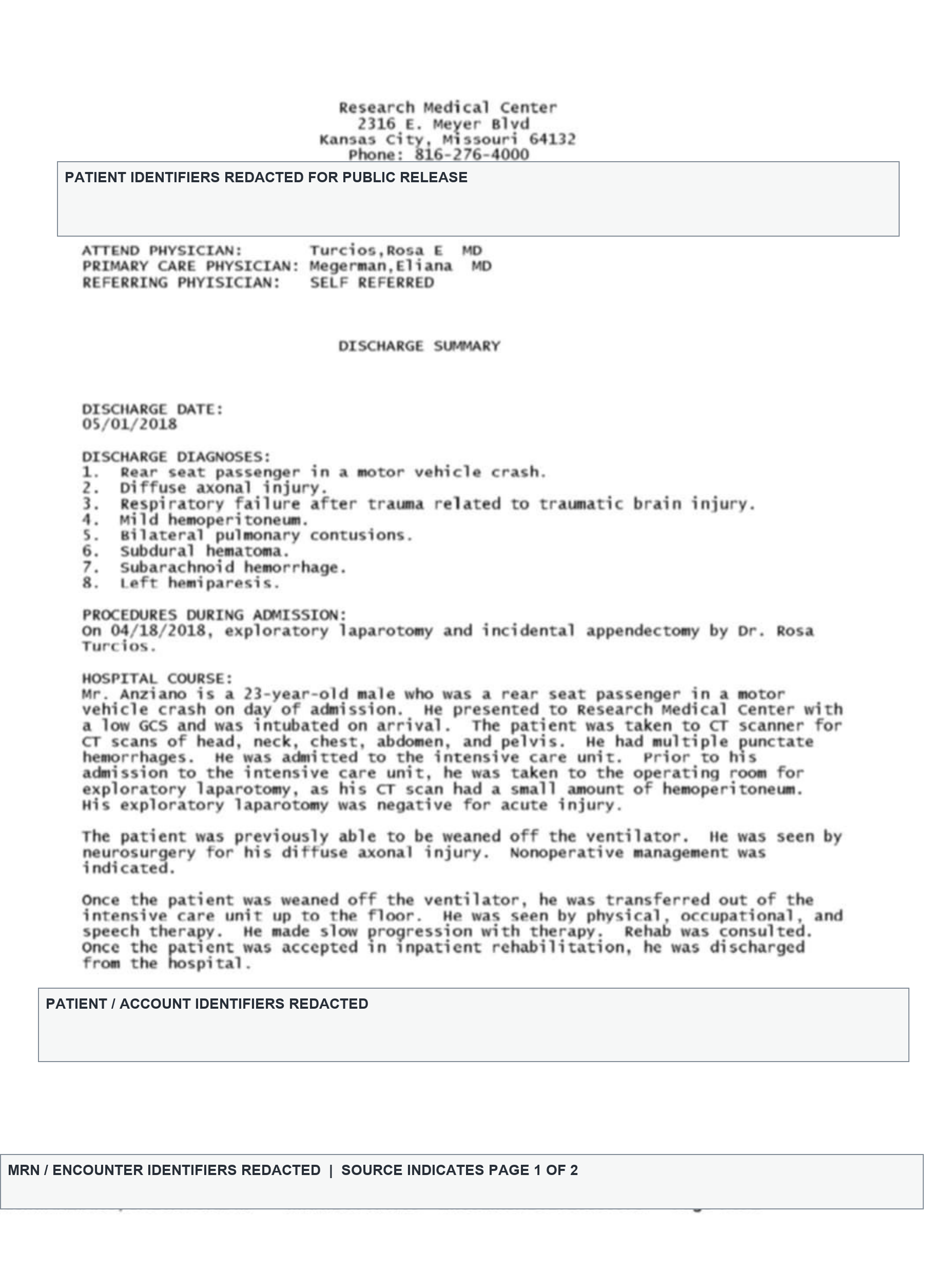
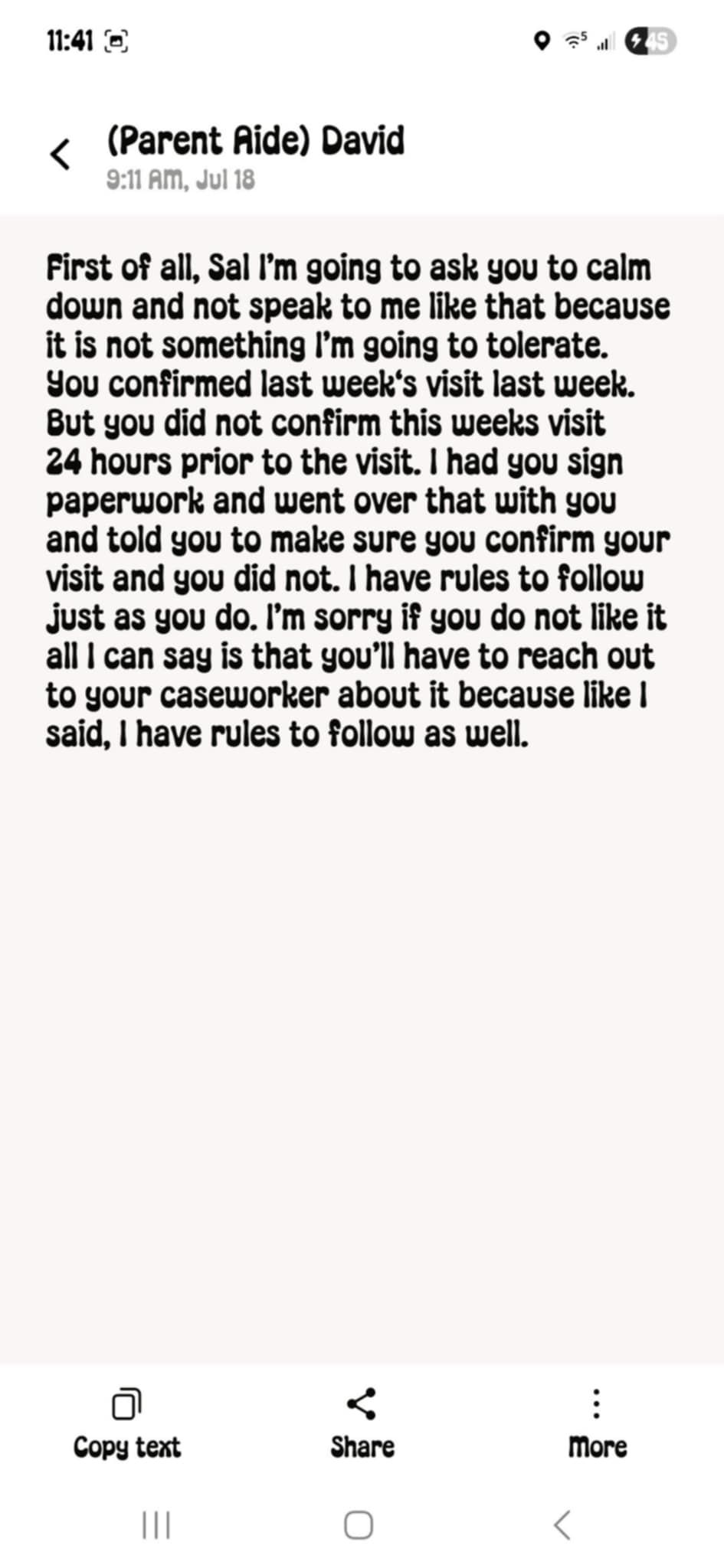
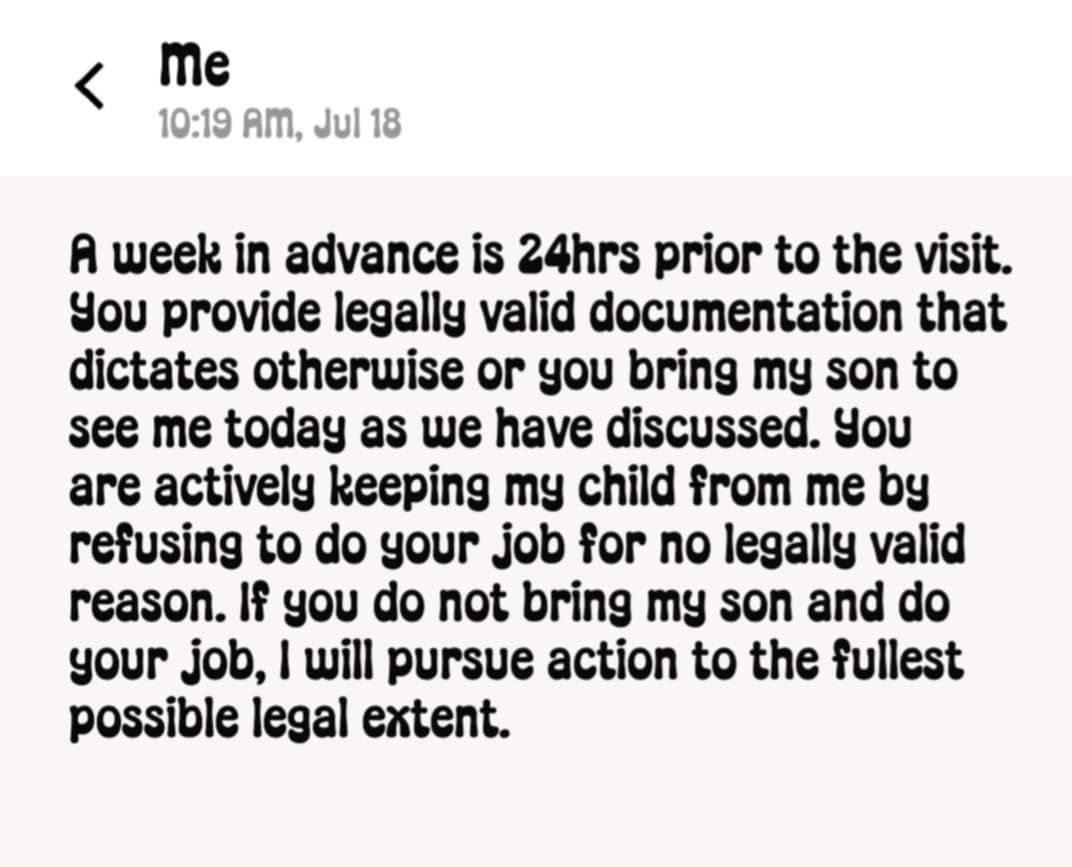
My hospital discharge documents a traumatic brain injury. I later disclosed disability-related access barriers, requested workable visits, and remained subject to office-only visitation. DSS then cited missed visits and participation while those restrictions were in place.
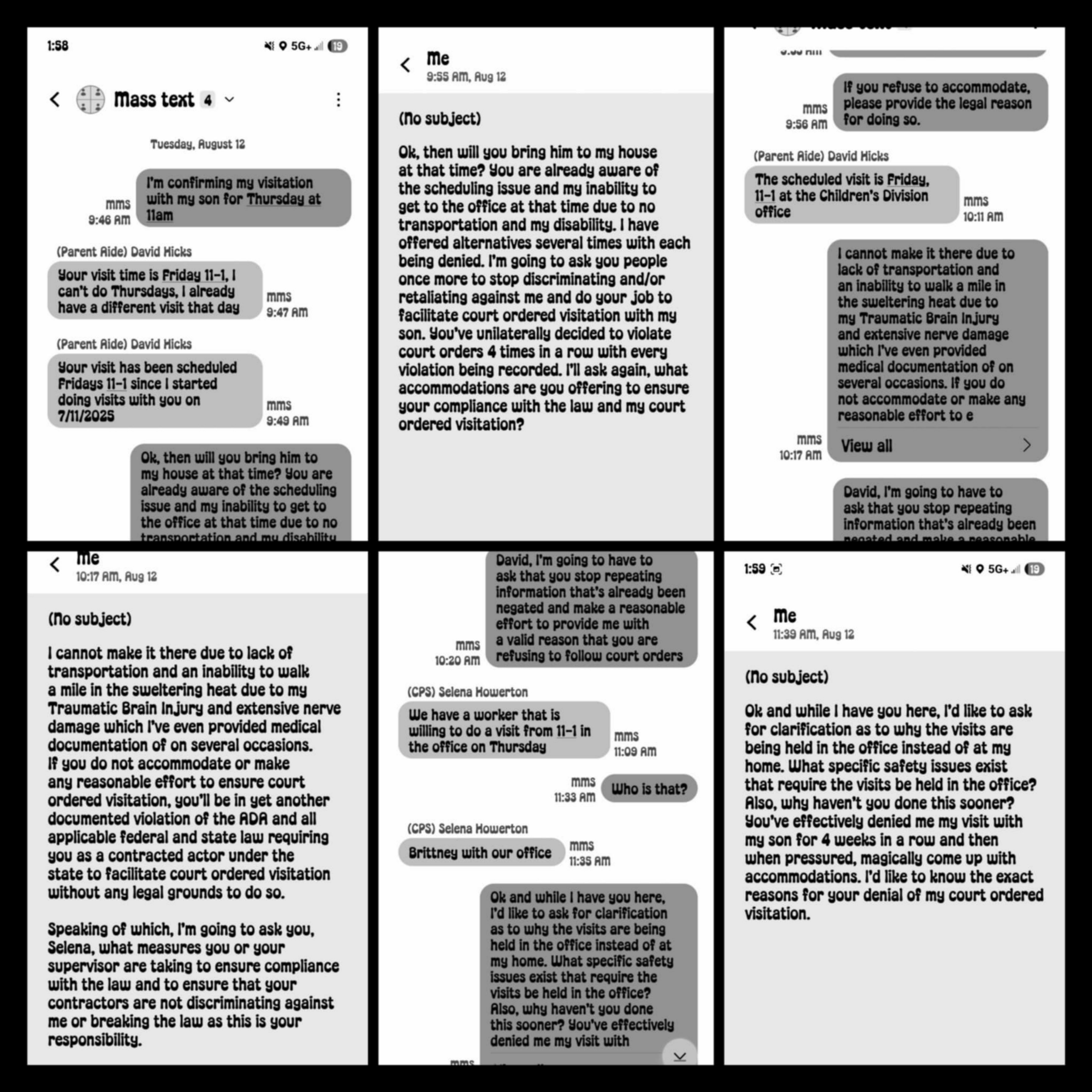
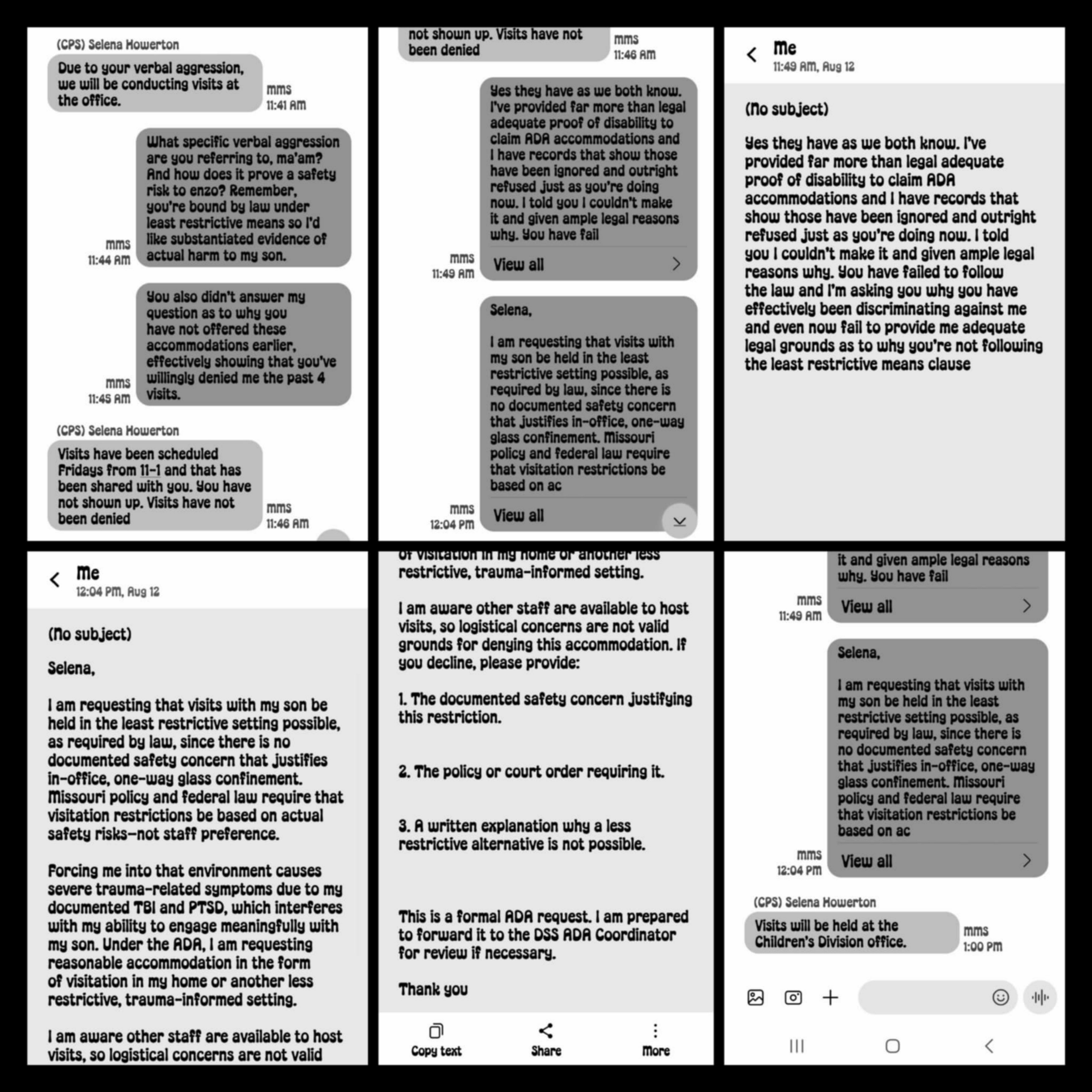
01 · CASE CHRONOLOGY
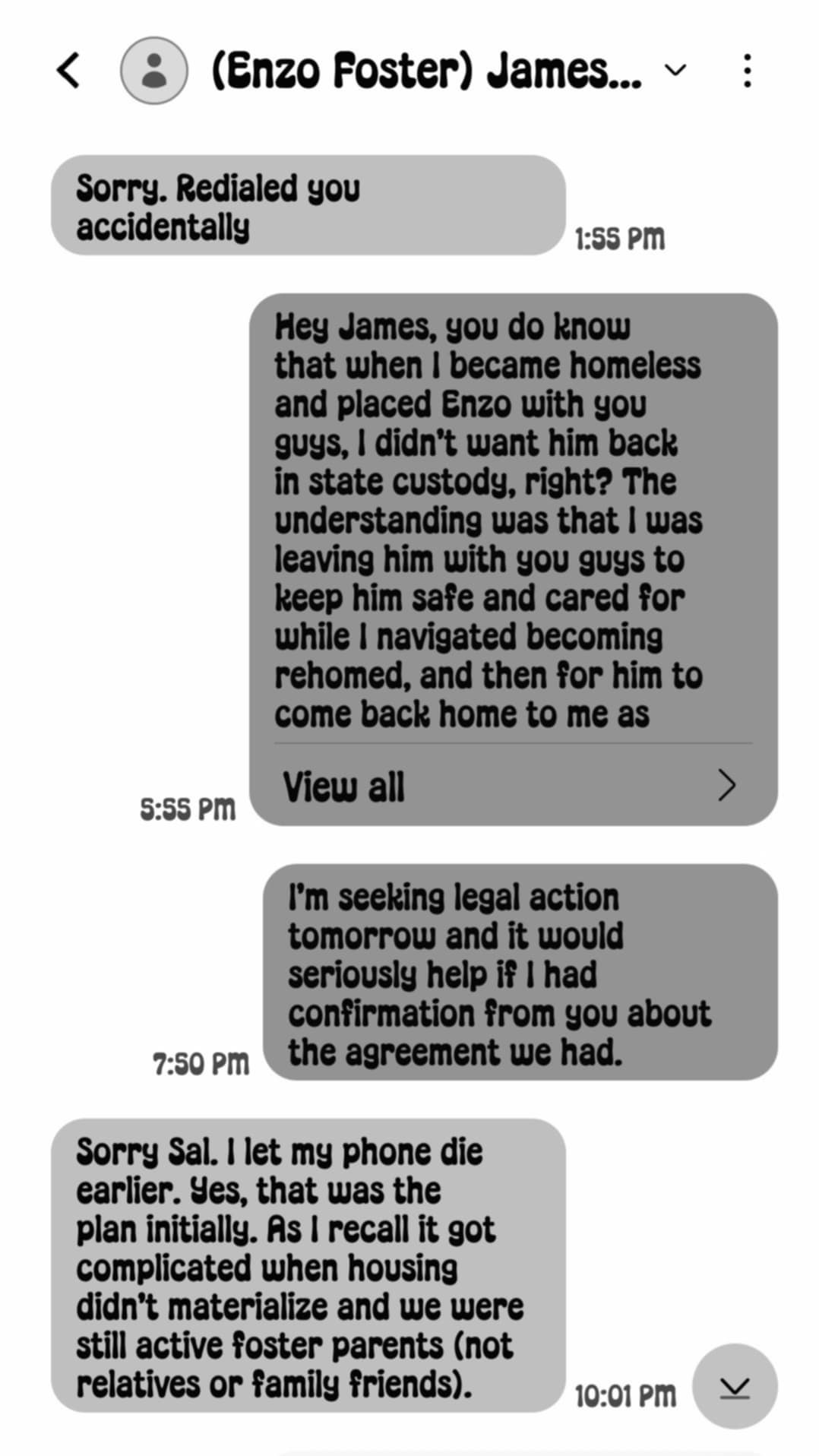
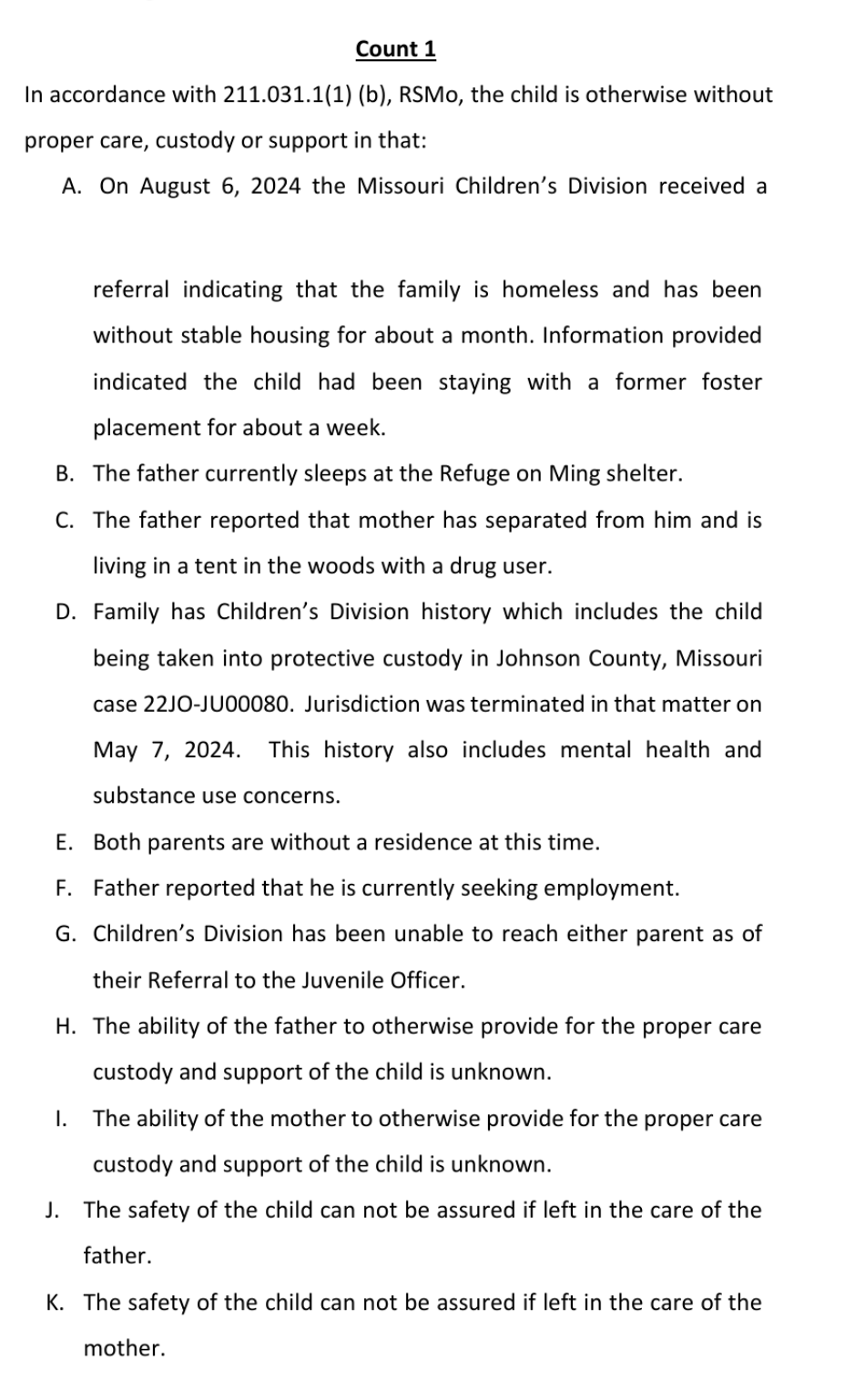
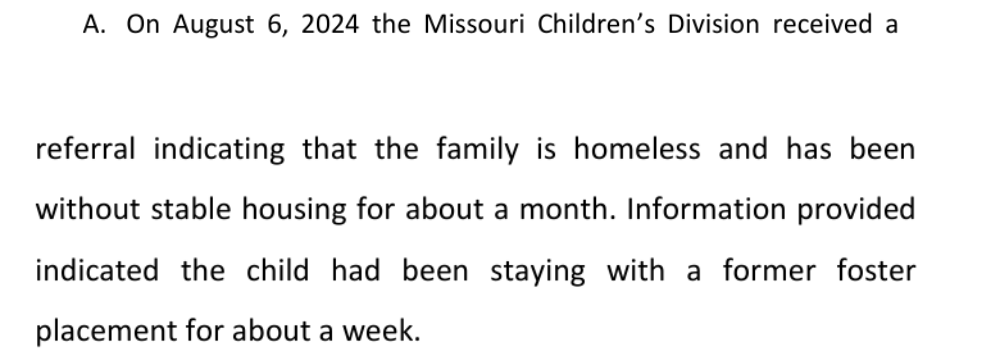

02 · CASE CHRONOLOGY
At the July 1, 2025 hearing, Teichman said: “You will follow the law. You will follow my orders, and you will do exactly what they tell you to do, or your child will stay stuck in this system until he's 21 years old.”
03 · CASE CHRONOLOGY
Teichman recused from the proceedings. The judge changed, but the restrictions I challenged did not end. His recusal marks the transition into the next stage of the case.
Attorney Bowers's email quotes a docket entry recording the recusal and transfer to Roach. This is correspondence quoting the entry, not the certified docket.
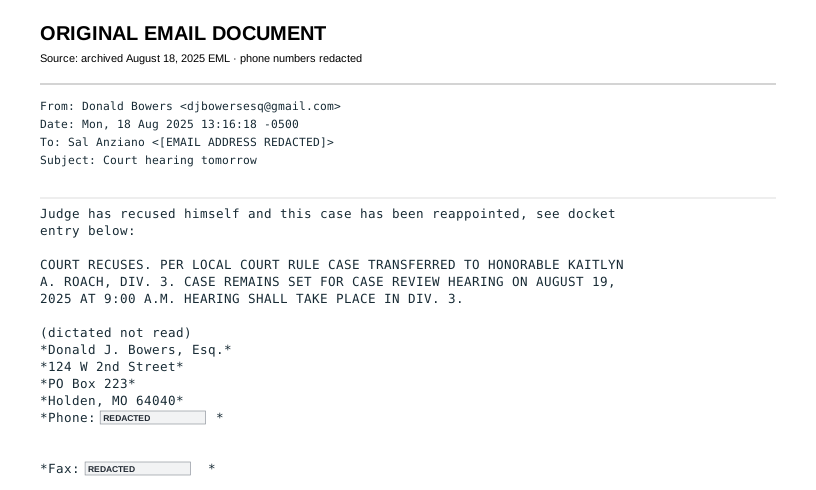
04 · CASE CHRONOLOGY
After Teichman's recusal, Judge Kaitlyn A. Roach presided over subsequent permanency proceedings in Enzo's juvenile case. I challenge the continuing custody and the decisions that kept Enzo from returning to me.

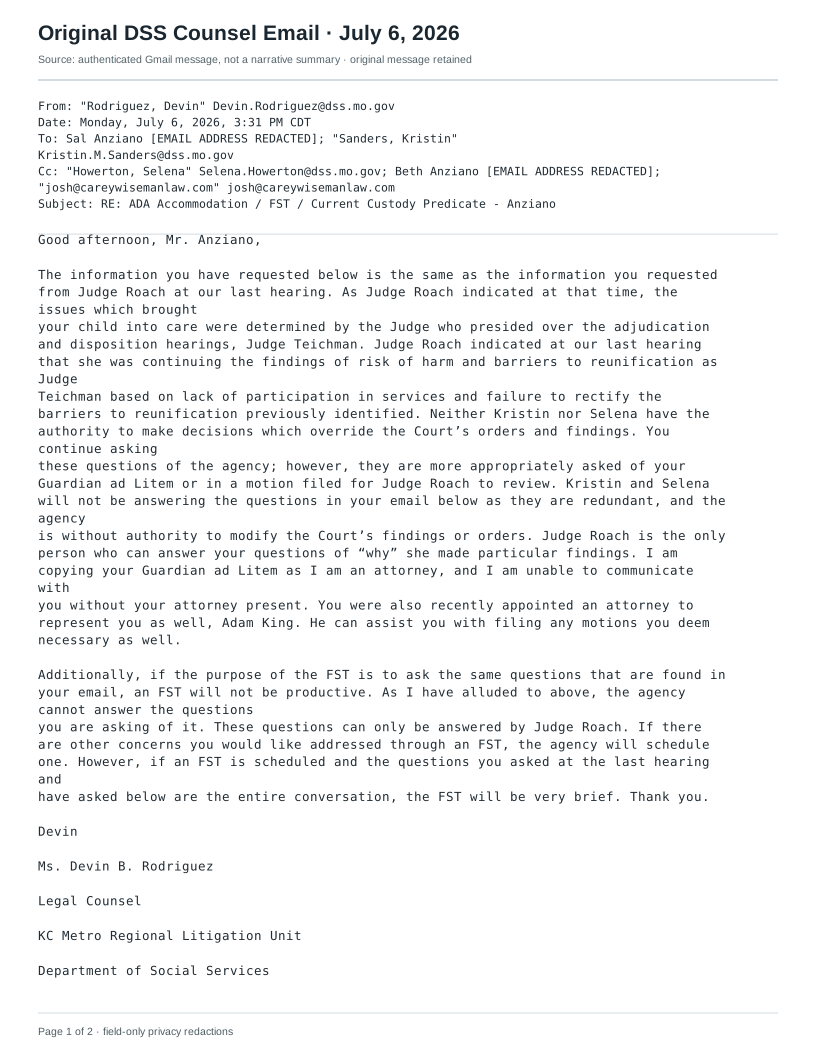
Division counsel's July 6 email describes Roach continuing Teichman's risk and reunification findings. This is counsel's account, not the underlying signed order.
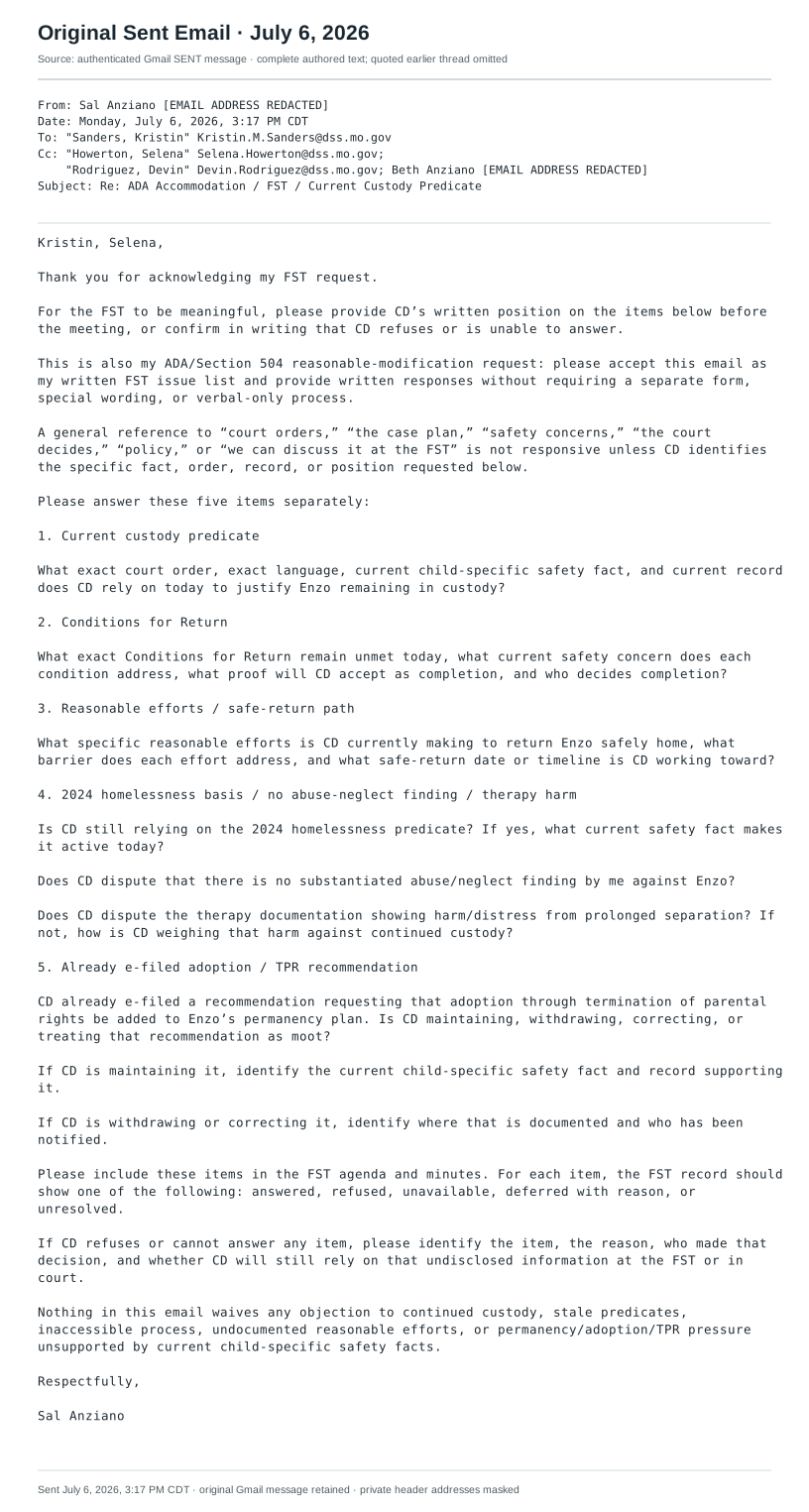
05 · CASE CHRONOLOGY
PUBLIC CASE NUMBER · 25JO-JU00052
Nicole went to the hospital thinking she had a UTI, learned she was unexpectedly pregnant, and Lucy entered a separate juvenile proceeding. The June 24, 2025 petition and custody order document that case. In March 2026, Nicole's attorney described Lucy's return as linked to progress in my Enzo case or Nicole leaving our shared home; Nicole later attributed the same restriction to a supervisor during an FST. I demand accountability for the effect of this cross-case condition on both children.
These documents identify Lucy's separate proceeding. The later restriction tied to the shared household is documented with the cross-case records under Block 7.
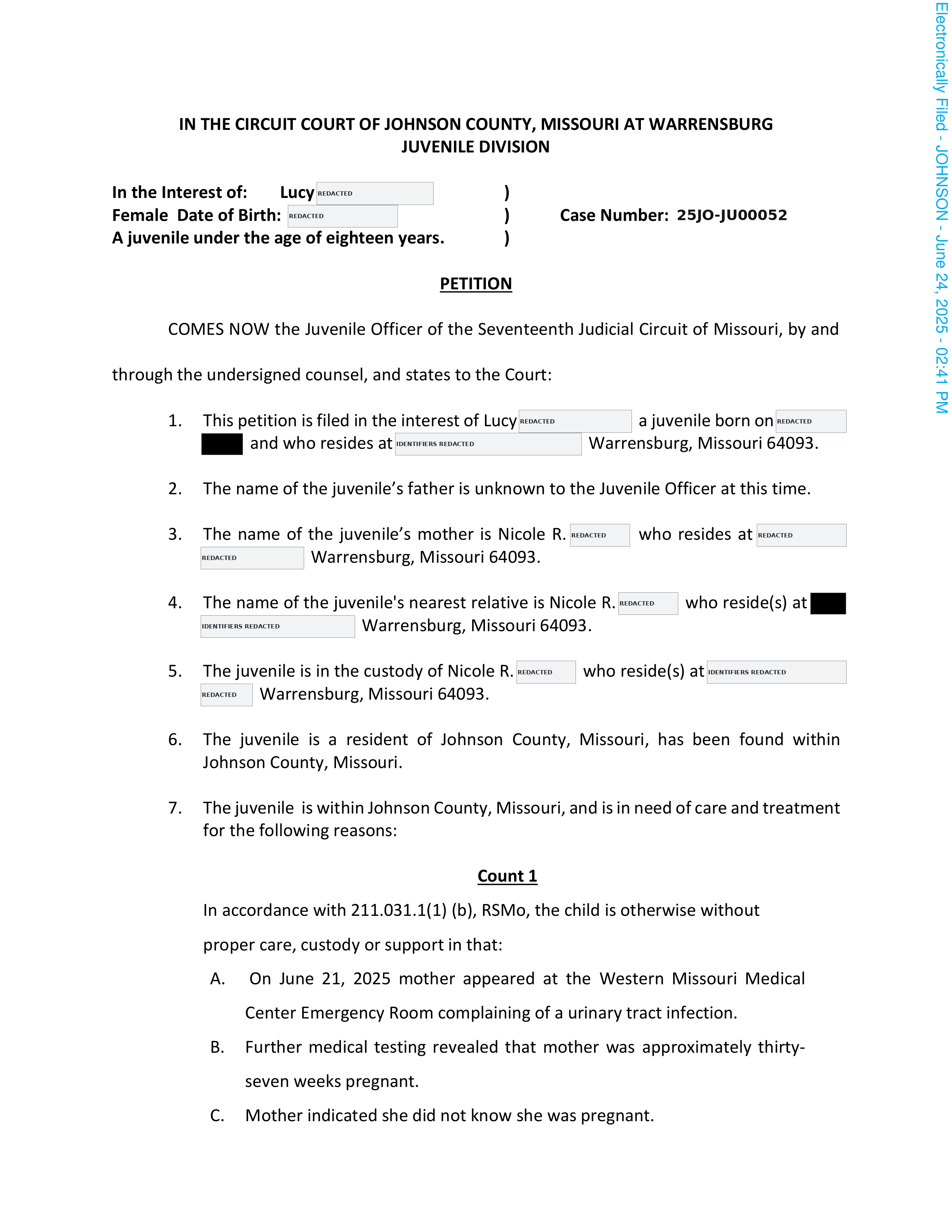
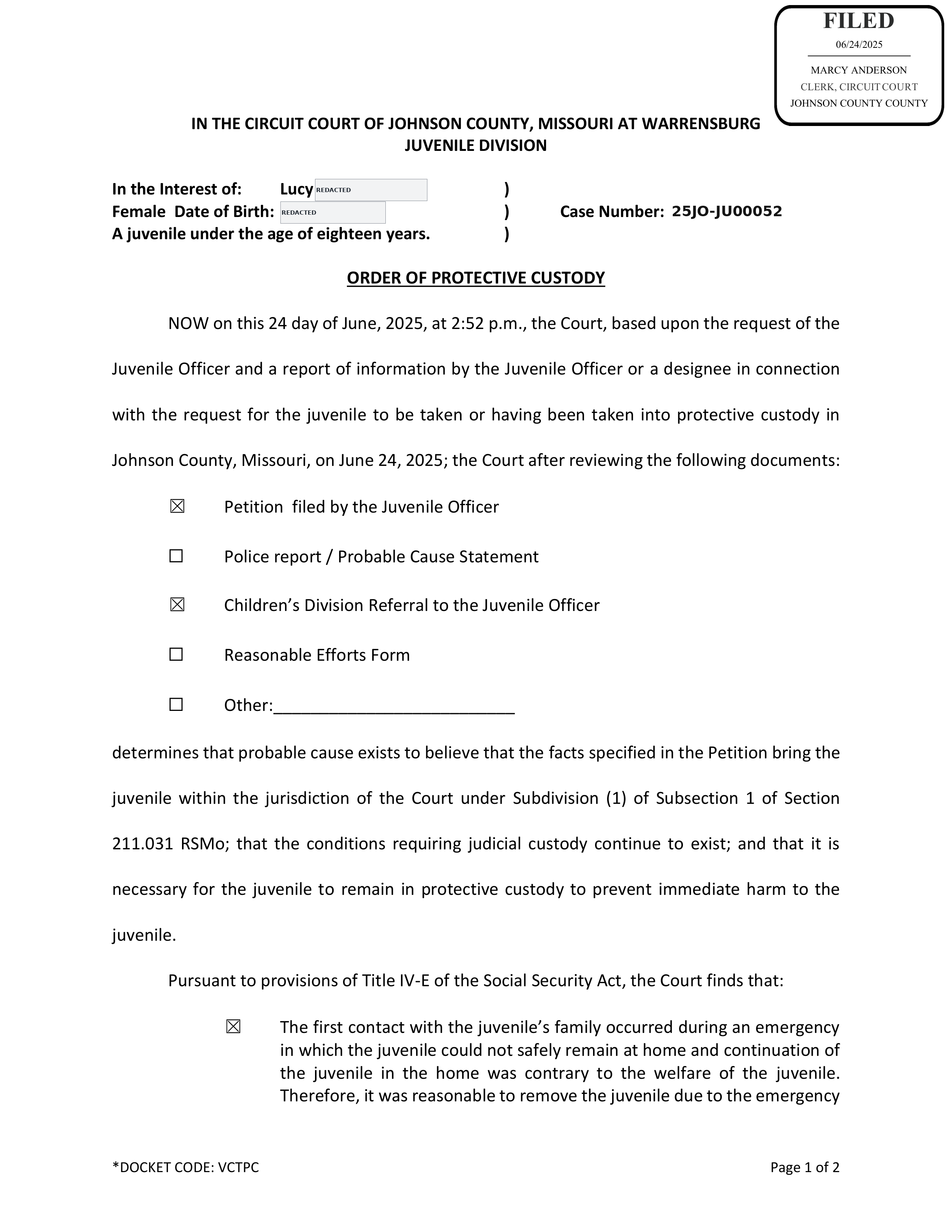
Read full redacted Lucy petition (PDF) · Read full redacted protective-custody order (PDF)
06 · CASE CHRONOLOGY
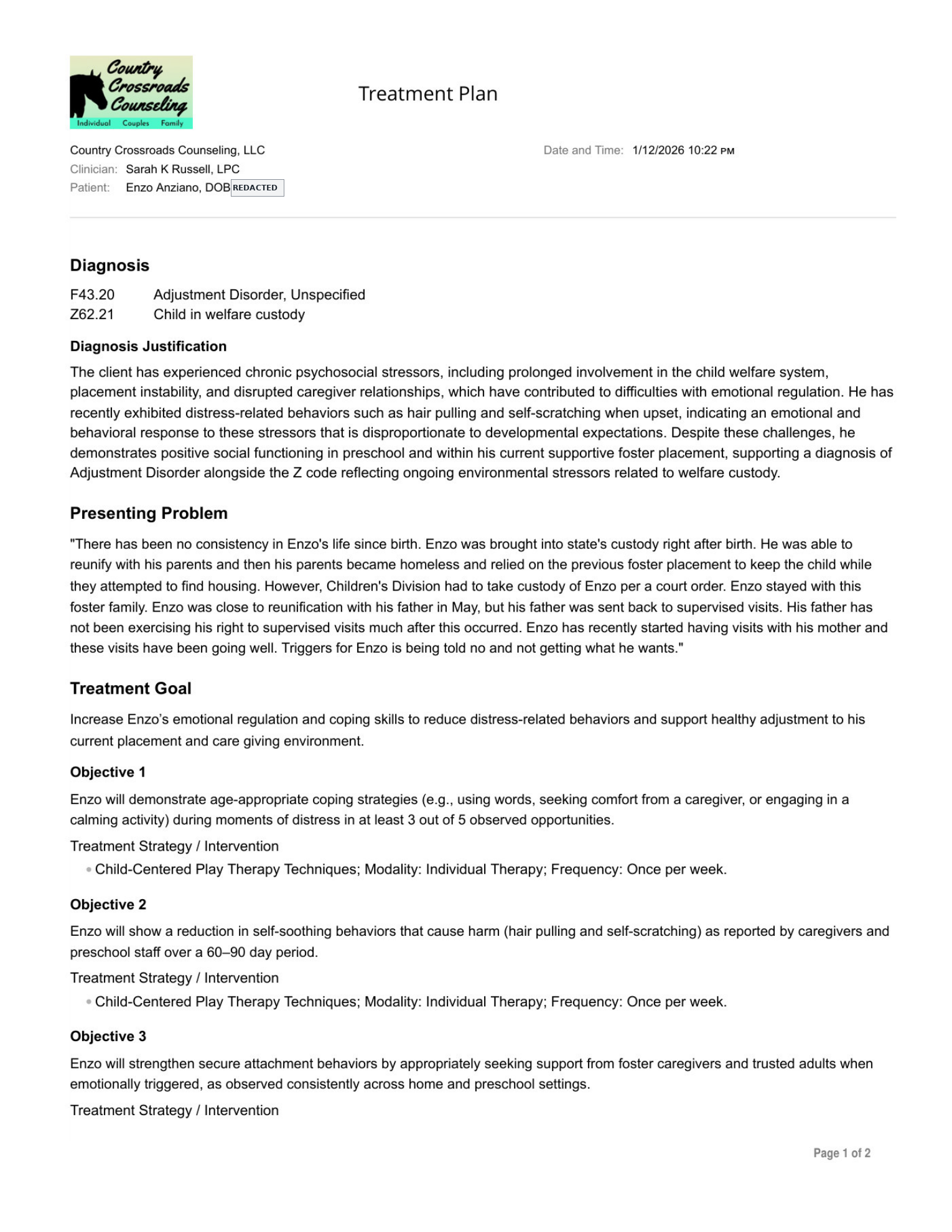
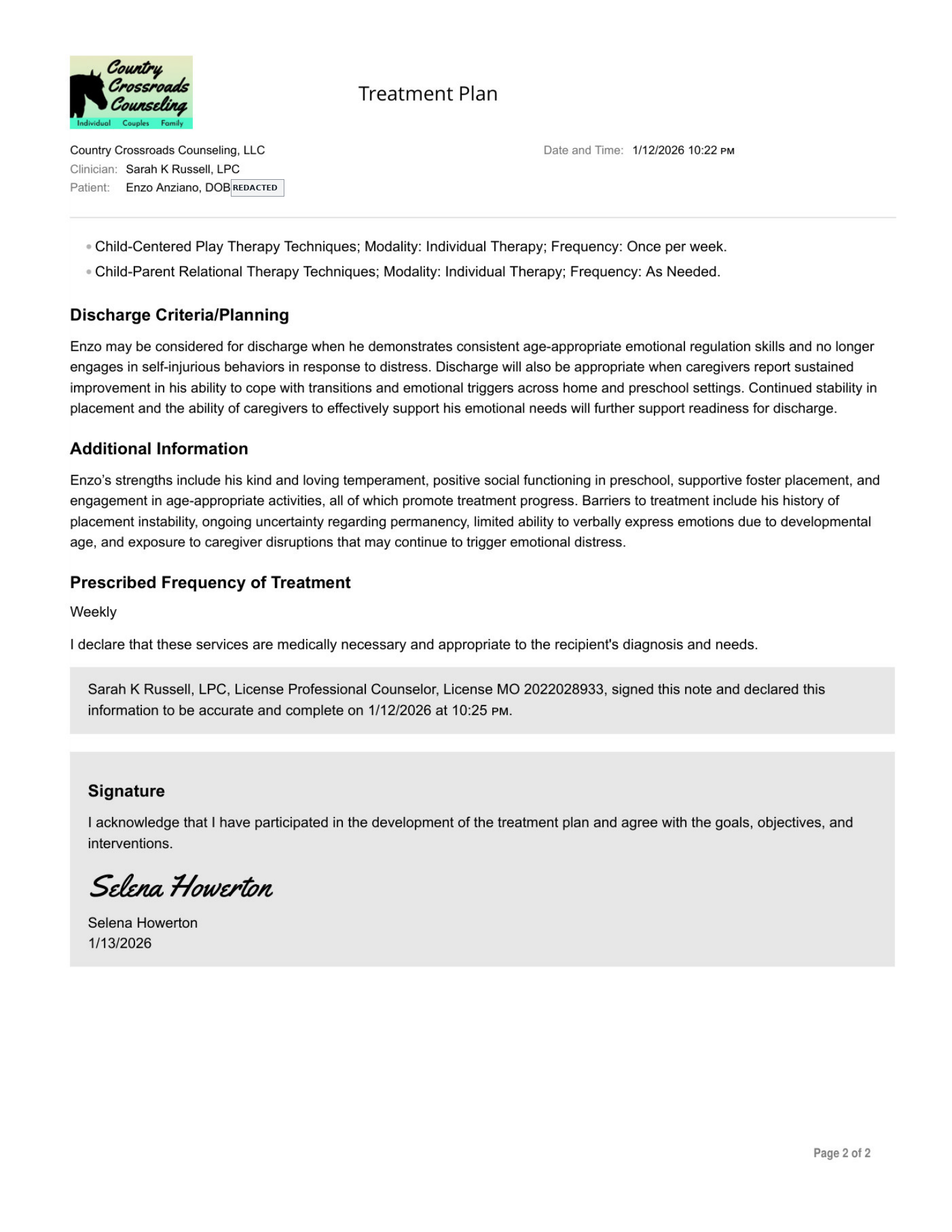
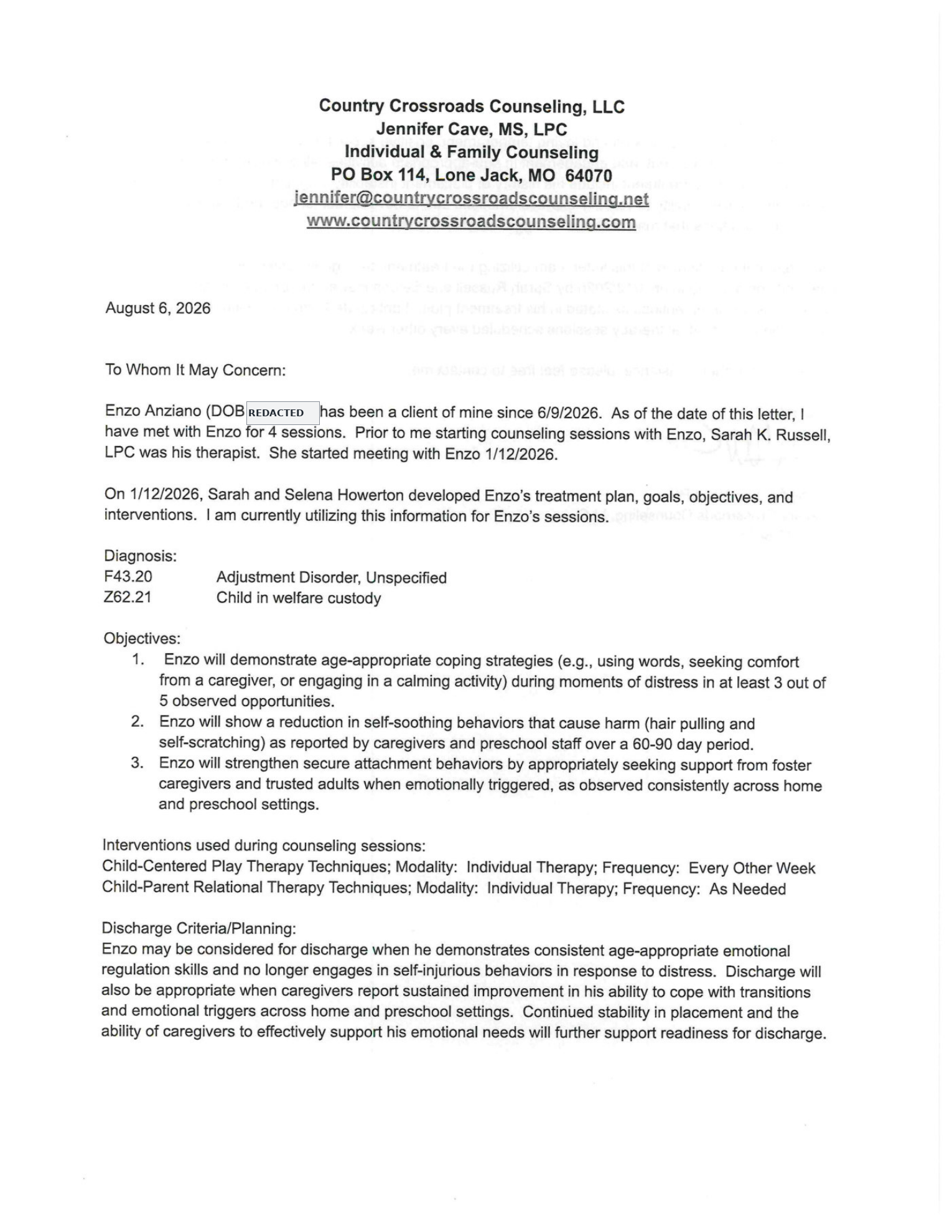
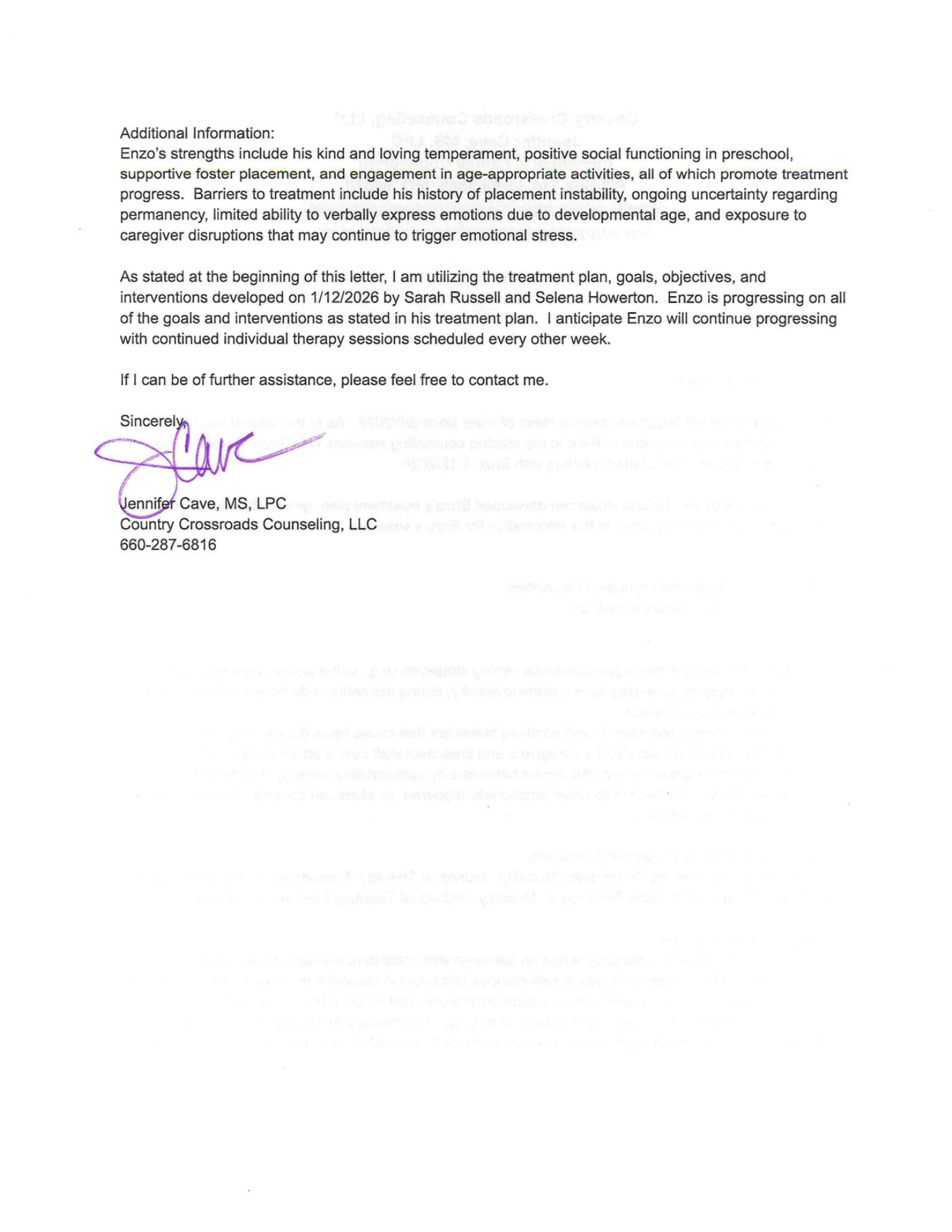
DSS filed Enzo's therapy report documenting self-injurious hair-pulling and scratching, along with disruptions in his care. I view that documented distress as a consequence of his separation and challenge continuing the separation while it was being reported.
The January 12 treatment plan and August 6 report document distress-related behavior and caregiver disruptions. The father's attribution of cause is distinct from the clinician's observations.
07 · CASE CHRONOLOGY
Enzo and Lucy were held in separate proceedings, but the pressure was the same: obey the demands imposed on my family or remain separated from my children. Their return was used as leverage, not reunification.
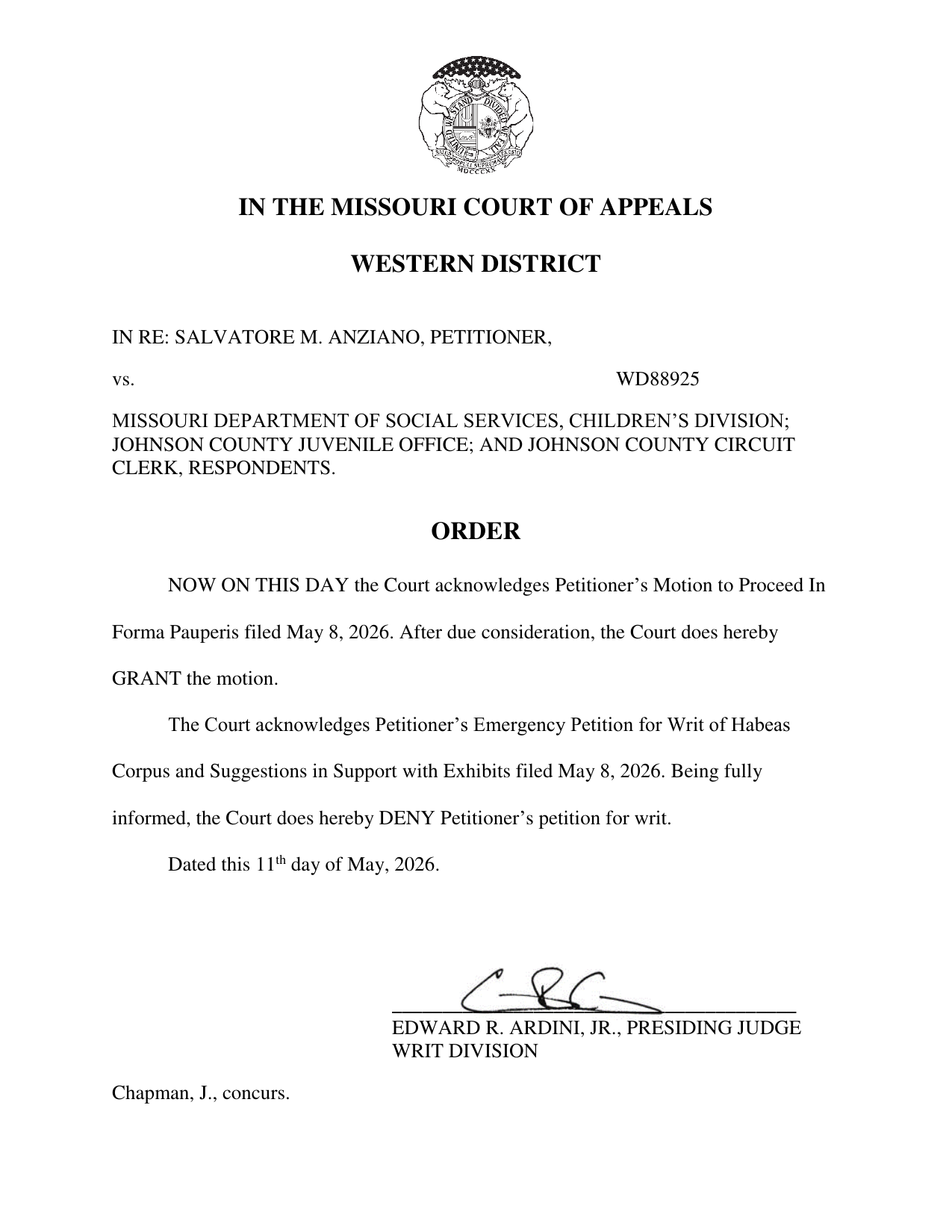
Teichman told me Enzo could remain in the system until age 21 unless I obeyed his orders and DSS's instructions. The July 1, 2025 trial-home denial focused on my conduct and compliance even after the Division's record supported Enzo's return. After Teichman's recusal, Division counsel reported that Roach continued his findings. The Western District denied my May 11, 2026 emergency writ without stating reasons.
The writ denials concern Enzo's case. Counsel's March 12 email and the FST record concern Lucy's return condition. Different cases, same pattern: the officials controlling their return made compliance the price of bringing my children home.
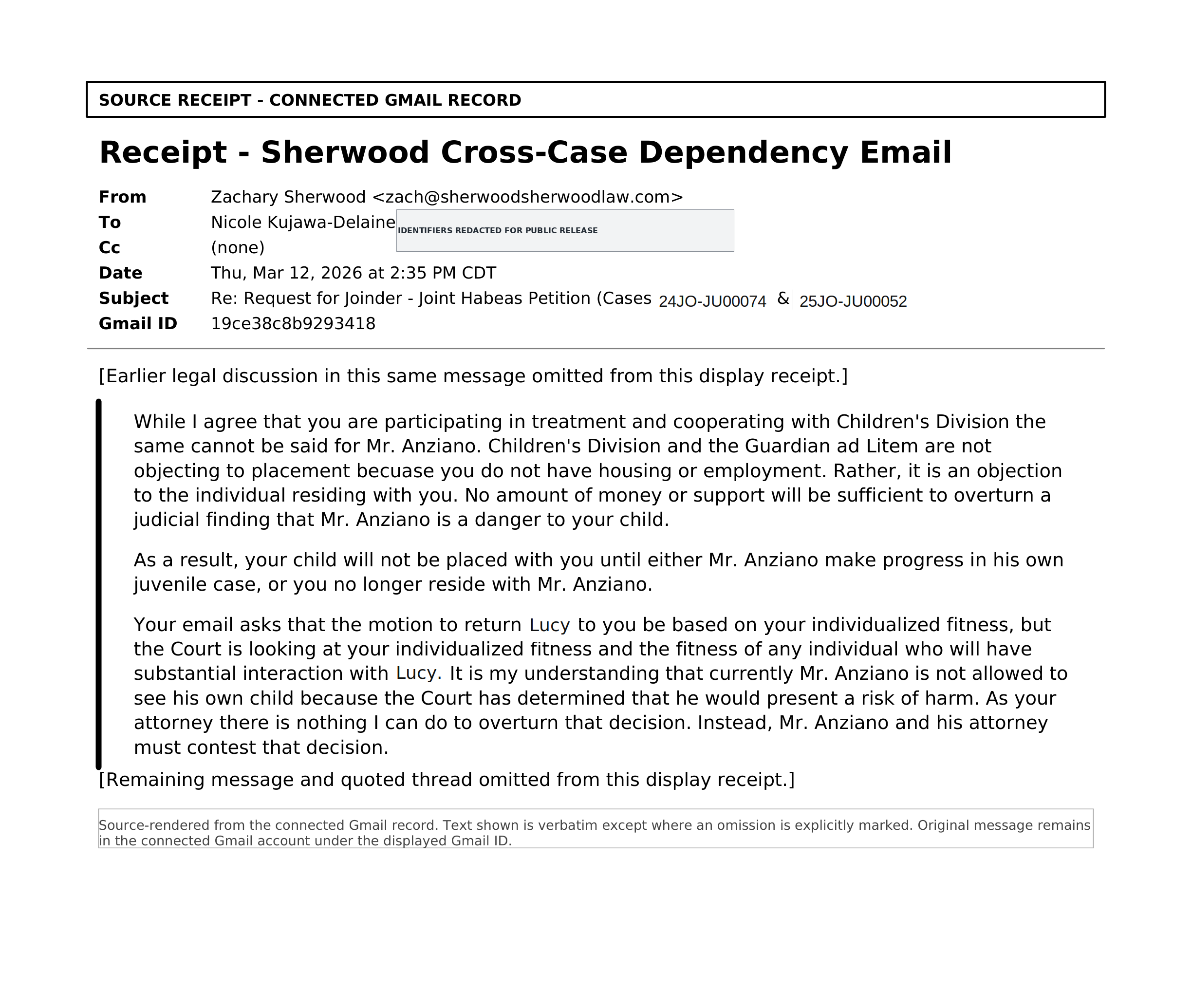
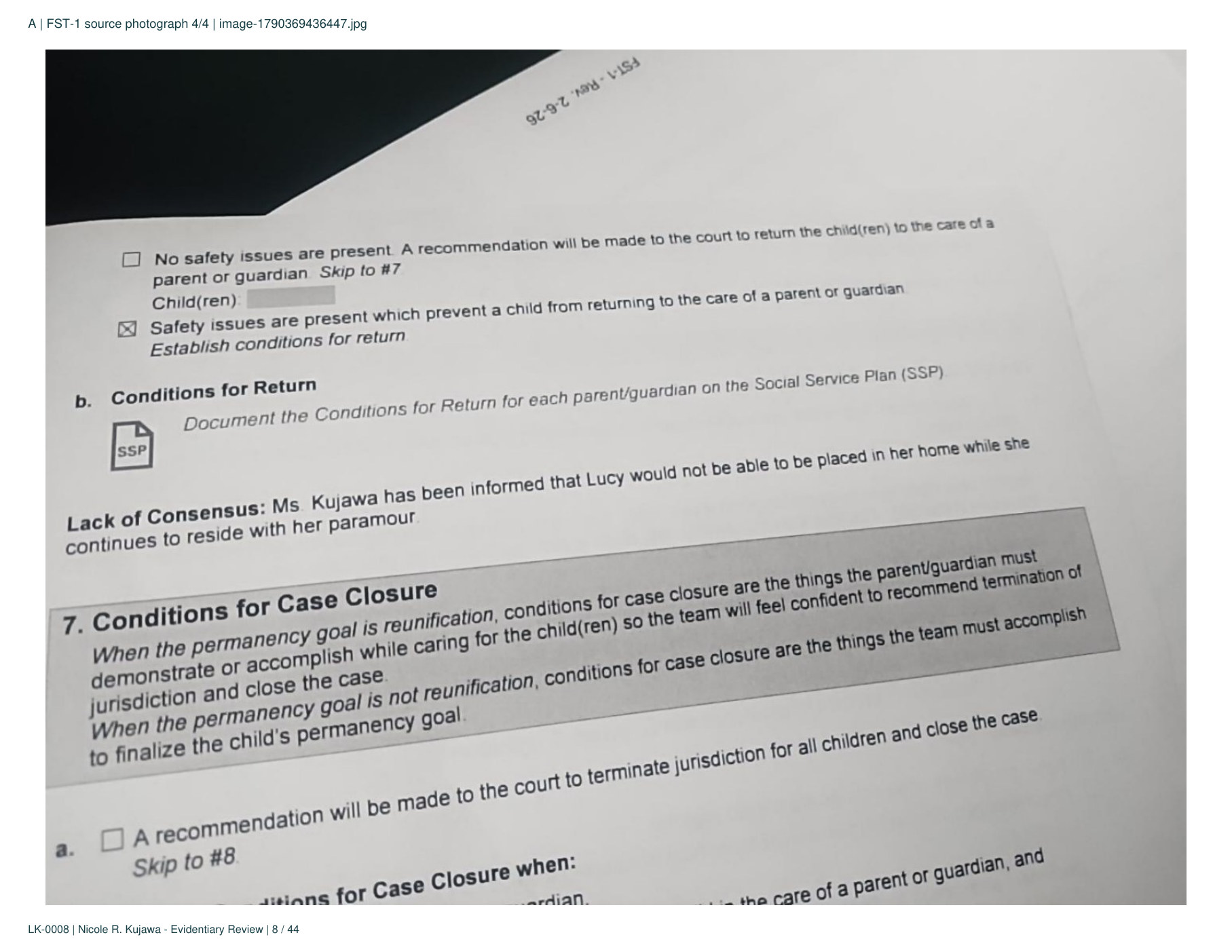
FST-1 · LACK OF CONSENSUS — SOURCE TEXT: “Ms. Kujawa has been informed that Lucy would not be able to be placed in her home while she continues to reside with her paramour.”
08 · CASE CHRONOLOGY
Five formal service emails document 23 Requests for Admission across four Children's Division sets and one separate set served on the juvenile through the guardian ad litem. The register tracks each response; five original service emails and two signed response attachments follow in chronological order.
DOCUMENTED DISCOVERY · EVIDENCE REGISTER
Five service sets · 23 individual requests · Case 24JO-JU00074
| RFA | Subject and disposition |
|---|---|
| 1.1 | No written individualized assessment supporting continued supervised visitationDeemed admission asserted · unanswered |
| 1.2 | No recorded Enzo-specific safety predicate supporting continued supervisionDeemed admission asserted · unanswered |
Service email: August 31, 2026. No Division response located through November 7, 2026.
| RFA | Subject and disposition |
|---|---|
| 2.1 | No written return-risk analysis addressing clinical permanency stressorsDeemed admission asserted · unanswered |
| 2.2 | Current Social Service Plan identifies no harm date after August 7, 2024Deemed admission asserted · unanswered |
| 2.3 | No written agency plan addressing Enzo's ongoing permanency uncertaintyDeemed admission asserted · unanswered |
Service email: August 31, 2026. Clerk confirmed the service certificate received and filed September 1. No Division response located through November 7.
| RFA | Subject and disposition |
|---|---|
| 3.1 | Division did not oppose a trial home visit at the July 1, 2025 hearingADMITTED |
| 3.2 | Division said co-resident CAN history did not prevent her from being around EnzoADMITTED |
| 3.3 | No signed Safety Plan after July 1, 2025DENIED · Division disputed the defined Safety Plan type |
| 3.4 | Current SSP identifies no present Father-based return riskDENIED · Division cited evaluation and visitation |
| 3.5 | No post-July 1 written safety justification for compliance demandsDENIED · Division cited court orders |
| 3.6 | No new written assessments after the first two sets' deadlinesOBJECTED · Division challenged the request's terminology |
Service email: October 7. Written Division response from counsel Devin Rodriguez, verified by Kristin Sanders: October 28, 2026.
| RFA | Subject and disposition |
|---|---|
| 4.1 | No professional disability-to-harm or unfitness opinion at June 1 court reportAwaiting response |
| 4.2 | July 1 judicial statements, later recusal, agency notice and compliance conditionsAwaiting response |
| 4.3 | Division's receipt of clinical records describing Enzo's distressAwaiting response |
| 4.4 | Visitation restrictions and disability accommodation requests versus noncooperation characterizationAwaiting response |
| 4.5 | Cross-case recusal notice and the co-residence barrier to Lucy's returnAwaiting response |
| 4.6 | No individualized Lucy-specific assessment supporting that co-residence barrierAwaiting response |
| 4.7 | Relative placement proposed and acknowledged versus later signed court reportAwaiting response |
| 4.8 | Earlier anti-TPR/reunification order versus later adoption/termination positionsAwaiting response |
Service email: October 12. Completed service certificate emailed to the clerk October 12; clerk acknowledged receipt October 13. No Division response located through November 7.
| RFA | Subject and disposition |
|---|---|
| G.1 | No written post-recusal GAL safety assessmentOBJECTED · Relevance and ambiguity |
| G.2 | No record identifying any post-recusal Enzo-specific safety factOBJECTED · Relevance |
| G.3 | No GAL motion to expedite Enzo's permanency hearing after August 11ADMITTED · August 11 through September 1 only |
| G.4 | GAL not relying on a post-recusal safety fact to support supervisionOBJECTED · Relevance and ambiguity |
Service email: August 31. Written response from guardian ad litem Joshua Wiseman: September 1, 2026.
Status as of November 7, 2026. “Deemed admission asserted” records Father's Rule 59.01 nonresponse claim; it is distinct from an express written admission. Original private service correspondence and unredacted juvenile records are not republished here.
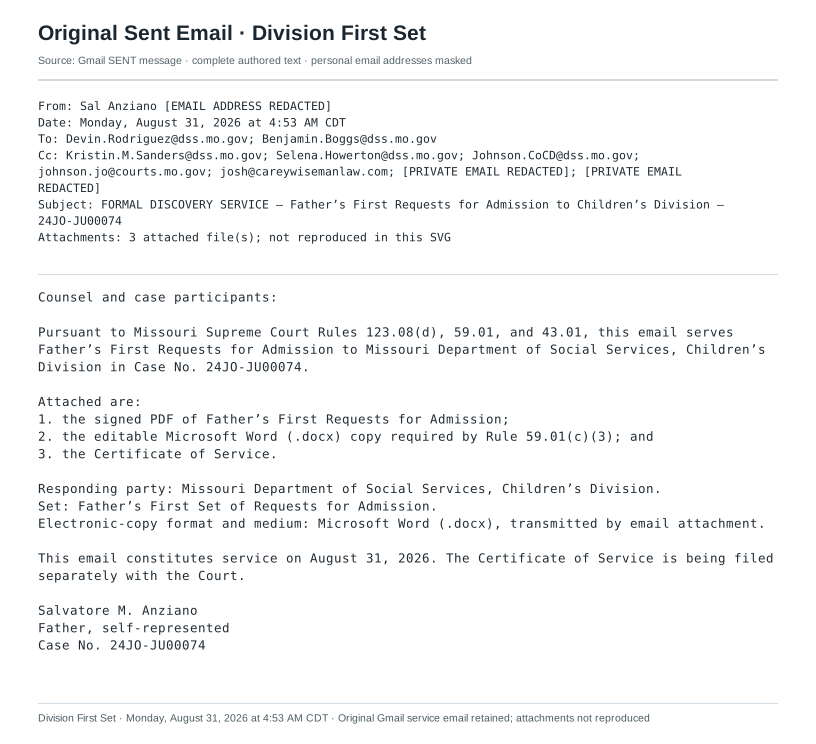
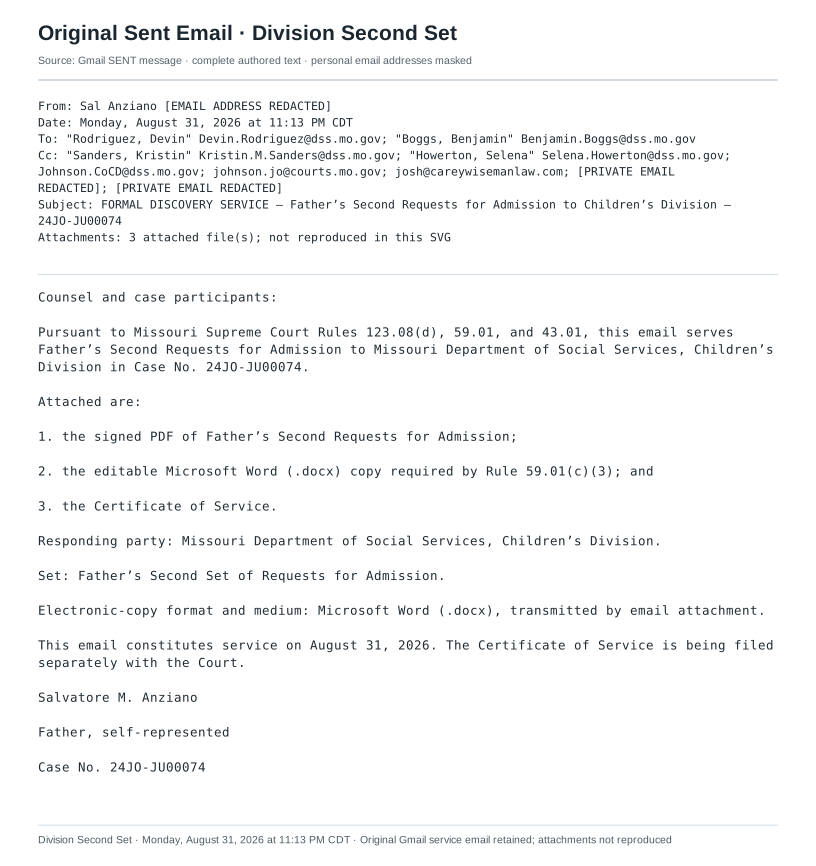
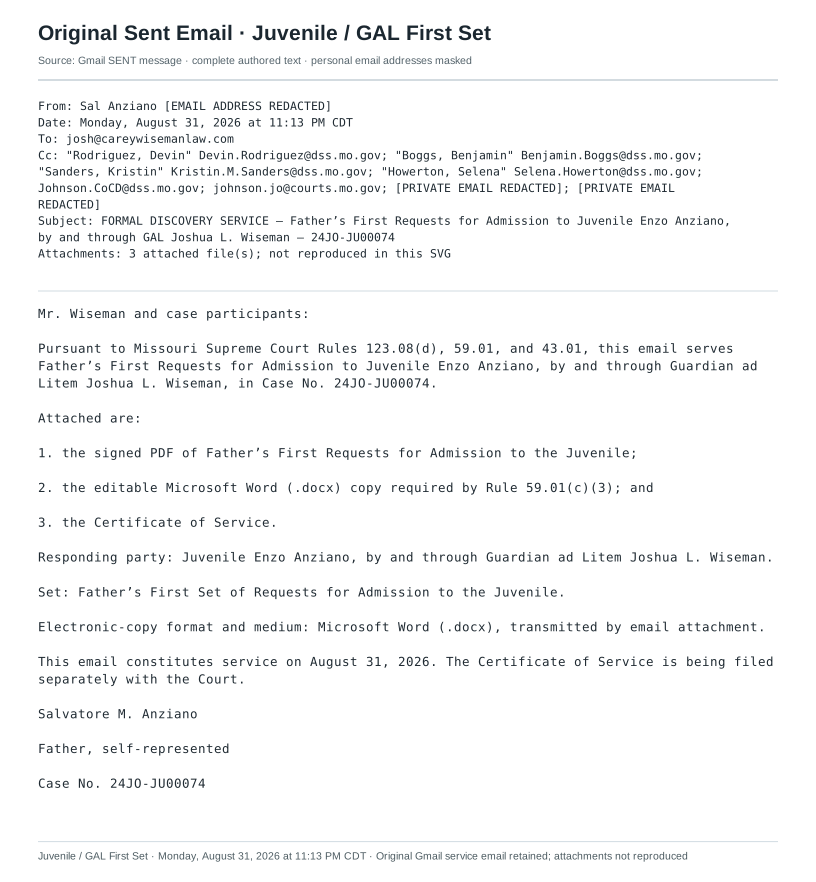
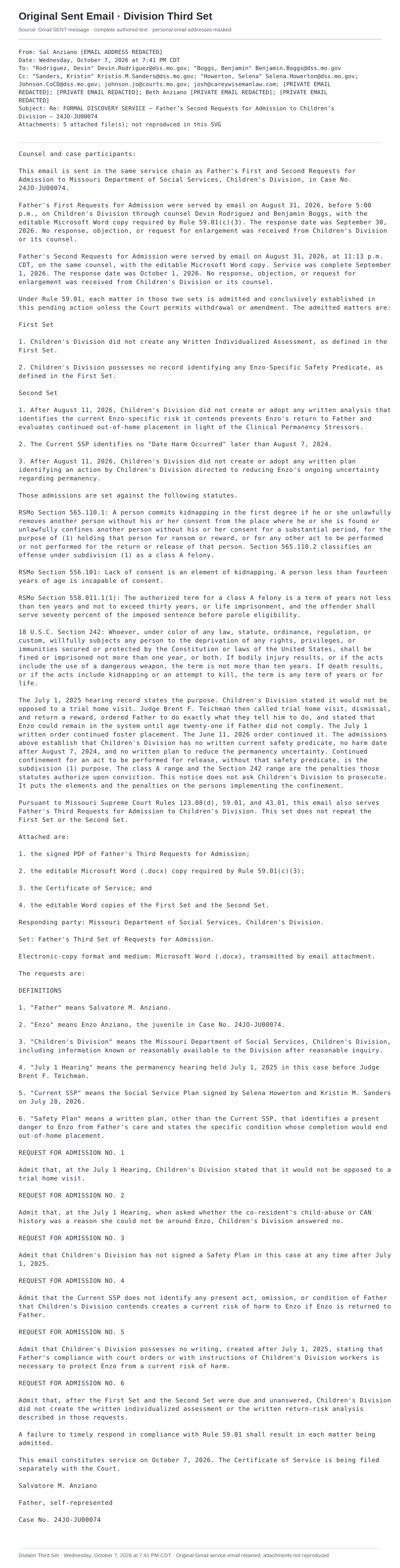
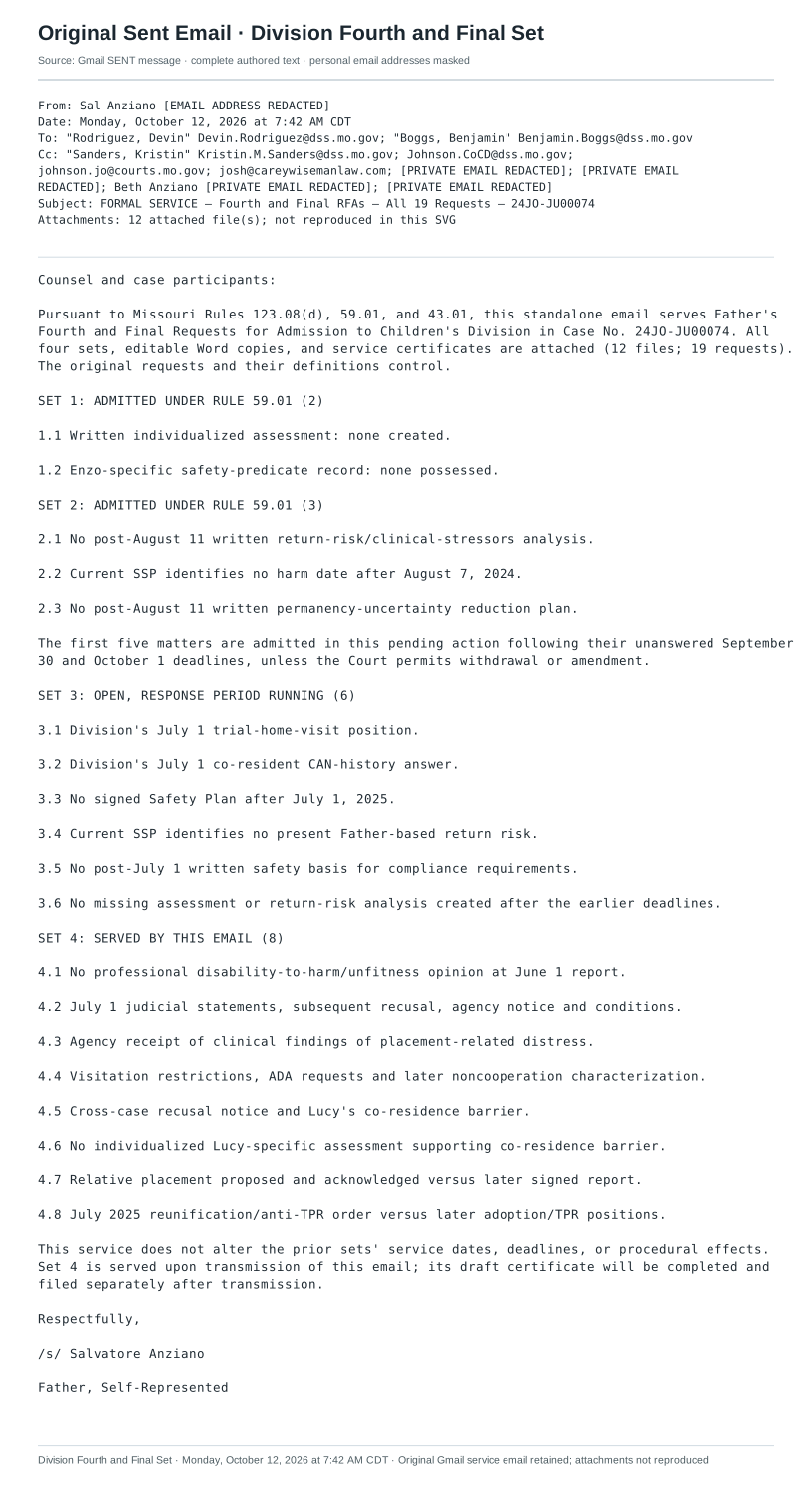
The five sent service emails are redacted SVG reproductions. The GAL and Children’s Division responses are the original signed PDF attachments, with the private recipient email removed from the public Division copy.
09 · THE EVIDENCE MEETS THE STATUTE
Missouri § 565.110.1(1) addresses unlawful confinement to compel an act in exchange for release. Read what the attorney told the court, what the judge demanded, and what the agency recorded.
Enzo remained in Children's Division custody. At the July 1 hearing, my attorney Don Bowers told the judge: “There is no safety concern...” and “There's no reason that jurisdiction shouldn't be released at this time...” DSS later reported no responsive records of substantiated abuse or neglect by me against Enzo.
Bowers's exact courtroom excerpts · Original recording · DSS records response
In that same hearing, Teichman said Enzo could have been returned six months earlier—or even that day—but had not because I was a “jerk.” He then made the price of return explicit: “You will follow the law. You will follow my orders, and you will do exactly what they tell you to do, or your child will stay stuck in this system until he's 21 years old.”
Hear Teichman in the July 1 recording · Recorded obedience demand
After Teichman recused, Roach continued his findings. DSS's signed answers cited evaluations, visits, and obedience to court orders; its earlier safety-record requests went unanswered. Lucy's return was separately conditioned on my Enzo case progressing or Nicole no longer living with me. The demand carried across two cases.
Roach continuation · Signed answers and RFAs · Lucy's written return condition
CLASS A FELONY KIDNAPPING. The court recording identifies the demanded obedience. The custody records show continued separation. The attorney's courtroom statements and DSS's own records confront the asserted safety rationale. Under RSMo § 565.110.1(1), unlawful confinement to obtain an act for release is first-degree kidnapping; § 565.110.2 makes it a Class A felony.
10 · ACTOR × CHARGE MAP
One connected record, assigned to the people who signed, ordered, communicated, or implemented each act. This is an evidence-linked charging analysis: proposed counts are organized for investigation and prosecution, not presented as filed indictments or criminal convictions.
Circuit judge · Enzo and Lucy
TWO PROPOSED FIRST-DEGREE KIDNAPPING COUNTS · 18 U.S.C. § 242
Enzo: Bowers told the July 1 court there was no safety concern and no reason to retain jurisdiction. Teichman made obedience the stated condition of return, and Enzo remained in custody. Lucy: Teichman signed her separate protective-custody order; her later return was tied to Enzo's case and Nicole's shared household. These are two child-specific charging theories, not two convictions.
STATUTES: RSMo § 565.110 · 18 U.S.C. § 242
SOURCE: Bowers and Teichman in court · Original hearing audio · Lucy's signed custody order · Cross-case return condition
Circuit judge · Enzo
ONE PROPOSED FIRST-DEGREE KIDNAPPING COUNT · 18 U.S.C. § 242
After Teichman's recusal, Roach continued his risk and reunification findings, according to Division counsel's written account. Continued custody was challenged with the no-abuse records response, clinical evidence, disability requests, and specific demands to identify a current child-specific danger. The continuation is the alleged conduct; its legal purpose is assessed from the connected record.
STATUTES: RSMo § 565.110 · 18 U.S.C. § 242
SOURCE: Recusal record · Counsel's account of continuation · Signed safety-related responses
Children's Division supervisor
FALSE-EVIDENCE / TAMPERING THEORY · KIDNAPPING PARTICIPATION · CIVIL-RIGHTS DEPRIVATION
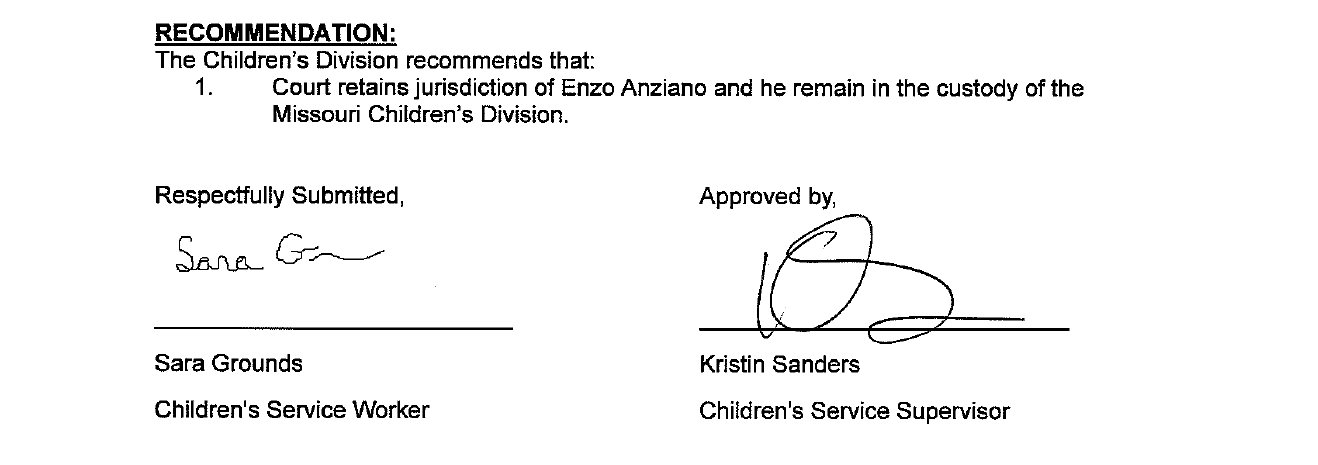
Sanders acknowledged the grandmother's placement offer in January, then approved a signed recommendation retaining custody while the case report stated no appropriate relative had been provided. She received written correction and clinical-harm notices; she also verified the Division's October RFA responses. That sequence links notice → report approval → continued custody recommendation. An offered relative and an approved relative are different questions; the actual screening record governs the false-evidence theory.
STATUTES: RSMo § 575.100 · § 565.110 · § 562.041 · 18 U.S.C. § 242
SOURCE: Published report statement · Signed approval · Therapy records · Verified Division responses
Children's Division caseworker
VISIT-RESTRICTION / FALSE-RECORD THEORY · KIDNAPPING PARTICIPATION · CIVIL-RIGHTS DEPRIVATION
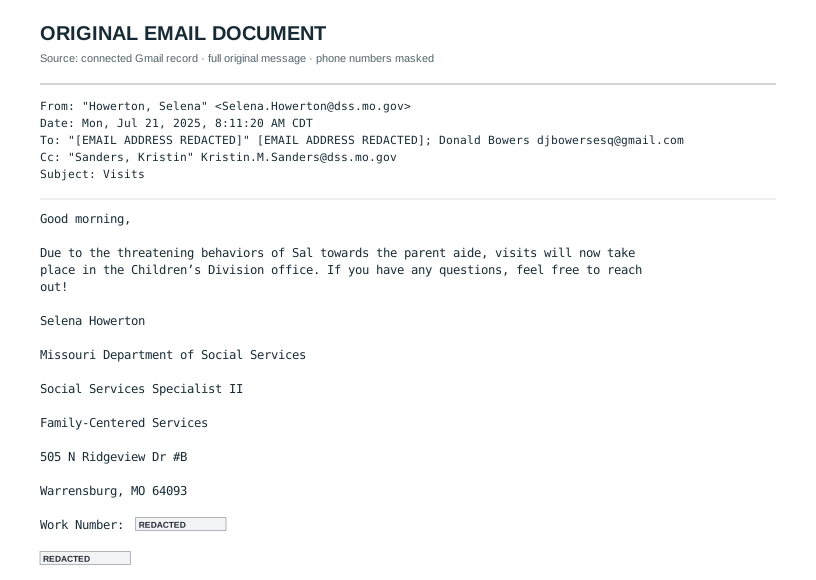
Howerton's July 21 email characterized the parent's conduct as threatening and moved visits to the Division office. She was copied on the grandmother-placement discussion and on written safety and disability-access demands. Later Division explanations relied on missed visitation. The evidentiary chain tests whether an agency-imposed restriction was then treated as parental noncooperation.
STATUTES: RSMo § 575.100 · § 565.110 · § 562.041 · 18 U.S.C. § 242
SOURCE: Disability records and restriction · Howerton's dated email · Original caseworker audio · Visitation-related RFA answers
Children's Division worker
FALSE-EVIDENCE / TAMPERING THEORY · DEPRIVATION-OF-RIGHTS REVIEW
Grounds signed the custody recommendation approved by Sanders and received the June correction about the grandmother's offer and home-visit cooperation. Agency reports and subsequent custody recommendations must be compared with what she was told before signing or relying on those statements. This entry attributes the report signature to Grounds—not Howerton.
STATUTES: RSMo § 575.100 · 18 U.S.C. § 242
SOURCE: Grounds/Sanders signed recommendation · Relative-placement statement · Continued-custody records
Children's Division litigation counsel
CONSPIRACY-AGAINST-RIGHTS THEORY · DEPRIVATION-OF-RIGHTS REVIEW
In writing, Rodriguez attributed Roach's continued findings to nonparticipation and unresolved barriers. Her email stated Sanders and Howerton would not answer the five current-safety questions. Rodriguez later transmitted signed Division responses. Those documents establish her notice, communication, and litigation role; a § 241 count additionally requires evidence of an agreement to violate rights.
STATUTES: 18 U.S.C. § 241 · 18 U.S.C. § 242
SOURCE: July 6 counsel response · October 28 signed responses
Children's Division counsel
CONSPIRACY / PARTICIPATION THEORY FOR EXAMINATION
Boggs was included in the January grandmother-placement correspondence and was subsequently served in the discovery chain. These records place him on notice of the relative-placement issue and custody dispute. A charge under § 241 or accomplice liability under § 562.041 requires his individual agreement or purposeful participation, not simply receipt of correspondence.
STATUTES: 18 U.S.C. § 241 · RSMo § 562.041
SOURCE: Dated discovery-service chain · Continuing-custody record
Juvenile-office initiating petitioner
PETITION-RECORD ACCURACY · § 575.100 REVIEW
Manford signed Lucy's initiating petition. Match each material statement in that petition against the contemporaneous records, including the separate protective-custody order and later household-return condition. Any evidence-tampering charge depends on a knowingly false material record and purpose to mislead, not the signature alone.
STATUTES: RSMo § 575.100
SOURCE: Original Lucy petition and order · Later return restriction
Guardian ad litem
DOCUMENTED CONDUCT · NO CRIMINAL COUNT ASSIGNED FROM THIS RESPONSE ALONE
Wiseman's signed RFA response expressly admitted that he filed no motion to expedite during the specified post-recusal period, while objecting to other requests. This establishes the narrow procedural fact; it does not itself show a criminal agreement, willful deprivation, or kidnapping assistance.
STATUTES: 18 U.S.C. § 242 — legal test
SOURCE: September 1 GAL signed response
Circuit clerk
PUBLIC-RECORD TAMPERING THEORY · APPEAL TRANSMISSION REVIEW
The filing correspondence and asserted untransmitted appeal identify the records-transmission issue. For § 575.110, the relevant question is an unauthorized, purposeful concealment or suppression of a public record. Receipt of filings and an appellate transmission dispute do not alone establish that criminal act.
STATUTES: RSMo § 575.110 · 18 U.S.C. § 242
SOURCE: Appellate and custody records
Criminal-law boundaries: § 565.110 requires unlawful removal or substantial confinement for a prohibited purpose. § 562.041 assigns responsibility for another's offense only on the statute's terms; it is not a separate count. § 575.100 covers specified knowing use of false evidence. 18 U.S.C. § 241 addresses conspiracies against rights, and § 242 addresses willful deprivation under color of law. These are separate elements, not interchangeable labels.
Related noncriminal duties: RSMo § 210.565 governs relative-placement consideration; disability-accommodation and due-process obligations are evaluated separately from criminal counts.
Key source witnesses: Don Bowers's July 1 courtroom statements and Zachary Sherwood's March 12 written return-condition account are evidence sources, not names assigned criminal counts here. Original audio and already-public redacted records remain in Sections 1–9. No private email or unredacted juvenile record is newly published in this section.